(Photo: Pro Football Hall of Fame)
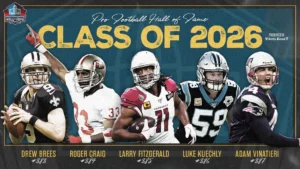
1. Drew Brees: The second he retired, we all knew this day would come. I knew he’d be a first-ballot Hall of Famer, and here we are. Drew is set to receive his flowers and be enshrined in Canton for the rest of time. He is the most prolific passers in the history of our sport, and those Saints offenses that ranked among the league’s best for so many years were powered by No. 9. I think what makes his path to the gold jacket even more impressive is the fact that he never played with a Hall of Fame-caliber wide receiver like Terrell Owens, Randy Moss, or Larry Fitzgerald. Imagine if he had. Drew finished his career with 571 passing touchdowns, which ranked first all-time until Tom Brady surpassed him. He now sits second on that list. There have only been 15 5,000-yard passing seasons in NFL history, and Drew accounted for five of them. This honor is incredibly well deserved for one of the all-time greats.
2. Larry Fitzgerald: What a legend, and what a career he built! One of the very best wide receivers I’ve ever seen play the game will take his rightful place among the greats in Canton, Ohio. To me, Larry Fitzgerald is the Tim Duncan of wide receivers, and as always, I’ll explain what I mean. He wasn’t necessarily the downfield threat that Randy Moss was or the physical specimen that Terrell Owens and Calvin Johnson were. Instead, he beat you with instincts and won his battles with craftiness rather than pure explosiveness. Because he didn’t rely on blazing speed, Larry’s game aged beautifully, allowing him to become a full-time slot specialist later in his career. He truly prided himself on the fundamentals of the position. Sometimes I wonder what his career would have looked like if he had played with a Hall of Fame-caliber quarterback. Today, he enters Canton with the second-most receiving yards in NFL history.
3. Luke Kuechly: I still remember when Luke Kuechly was drafted by the Carolina Panthers. It was the 2012 NFL Draft, and he was selected ninth overall. The rest is history. The second he stepped foot in Charlotte, Luke made an immediate impact, winning Defensive Rookie of the Year after leading the league with 164 tackles. There was no sophomore slump the following season, as he was named Defensive Player of the Year in 2013, becoming one of the youngest players in NFL history to win the award. Luke was one of the smartest defenders of his generation. He had the ability to diagnose plays before they developed, make adjustments at the line of scrimmage, and serve as the unquestioned leader of those Panthers defenses. Though his career was cut short, nobody was a better middle linebacker at their peak than Luke Kuechly. I can only imagine what else he would have accomplished had he not retired at just 28 years old.
4. Adam Vinatieri: The bigger the stage, the more clutch he became. There’s no kicker I’d rather have lining up a game-winning field goal than Adam Vinatieri. He joins Ty Law and Richard Seymour as another key member of the Patriots’ early dynasty to earn a place in the Pro Football Hall of Fame. Adam is the most clutch kicker I’ve ever witnessed, consistently delivering when his number was called. He spent the first 10 seasons of his career with the Patriots before finishing with the Indianapolis Colts. Vinatieri enters Canton as the NFL’s all-time leader in points scored and field goals made. He also owns four Super Bowl championships—three with the Patriots and one with the Colts.
5. Roger Craig: It’s about time! He should have been inducted years ago, but better late than never. Before Marshall Faulk, LaDainian Tomlinson, Christian McCaffrey, Jamaal Charles, and Alvin Kamara, there was Roger Craig. He was the first true dual-threat running back, excelling not only as a runner but also as a receiver out of the backfield. He was the perfect fit in Bill Walsh’s offensive system and became a reliable weapon for both Joe Montana and Steve Young. In 1985, Roger became the first running back in NFL history to record 1,000 rushing yards and 1,000 receiving yards in the same season. His influence on the modern dual-threat running back is still felt today, proving that running backs could be just as dangerous catching the football as they were carrying it. He’ll finally be where he belongs.
