
(Photo: Clutchpoints)
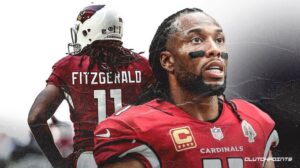
As I mentioned yesterday, some draft classes are so memorable, and another one to bring up is the 2004 NFL Draft. This is the draft when Eli Manning was the projected number one pick and became famously known for not wanting to play for the then–San Diego Chargers. With that being said, Eli was eventually traded to the New York Giants, and the Chargers acquired Philip Rivers. This is also the same class that saw Vince Wilfork go to the Patriots, Steven Jackson get drafted by the Rams, the late Sean Taylor get selected by Washington, and the Pittsburgh Steelers draft a quarterback named Ben Roethlisberger. That year, the Arizona Cardinals held the third overall pick, and they spent it on a wide receiver named Larry Fitzgerald out of Pittsburgh. Last year, Jared Allen became the first player from this draft class to become a Hall of Famer, and now Larry is the second, as he was elected to the Hall of Fame on the first ballot.
Larry is one of the greatest wide receivers I’ve had the privilege of watching. No, he wasn’t a pure speed threat or a field-tilter like Randy Moss or Terrell Owens. Instead, he won his battles with craftiness rather than explosiveness. Watching Larry play all those years, his hands were elite — I’m talking about putting him in the same category as the greats like Randy and Jerry Rice. The catch radius he had on display was phenomenal, and when the football was thrown in his direction, it felt like an automatic reception. I compare that to when you see Steph Curry shoot the basketball — you just have a feeling it’s going in. In contested-catch situations, number 11 was dominant. Larry is also the smartest wide receiver I’ve ever seen play the game. Again, he wasn’t a burner and wasn’t the type of player who would beat you with speed. Instead, he hurt secondaries with route IQ and body control. He could subtly push off and position himself for the ball. He knew how to identify coverages and settle into open spots in zone defenses, and he was elite when it came to leverage manipulation. He was strong at shielding defenders, and I can confidently say he remained productive past his prime years because his game wasn’t dependent on speed. Later in his career under Bruce Arians, he reinvented himself as a slot receiver and continued to give defensive backs fits at an advanced age. That move added more years to his career. Larry prided himself on the fundamentals of playing the position — footwork, route running, the ability to separate, catching the football, and gaining yards after the catch — which made him great year after year.
For as great as he was, just imagine if he had played with a Hall of Fame–caliber quarterback throughout his entire career. The best quarterback he played with, in my opinion, was Kurt Warner. Yet he was still able to produce with average quarterbacks such as John Skelton, Carson Palmer, and Kevin Kolb. Larry put together one of the best playoff performances I’ve ever seen from a wide receiver in 2008, recording 30 receptions for 546 yards and seven touchdowns in four playoff games. To put into perspective just how great he was, he has the second-most receptions of all time with 1,432, the second-most receiving yards of all time with 17,492, and 121 touchdowns in his career. The one stat that always stood out to me is that he had more tackles in his career (41) than dropped passes (29). Larry, to me, is the Tim Duncan of wide receivers. Like the Basketball Hall of Famer, he was never the flashiest or even the most athletic, but he was fundamentally sound and elite for many years.
