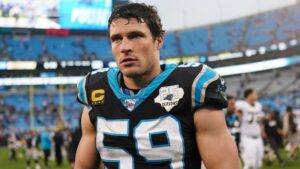
(Photo: Sky Sports)
Whenever I look back at memorable draft classes, the class of 2012 often stands out to me. This was the year Andrew Luck went first overall to the Indianapolis Colts and Robert Griffin III was selected second overall. It was also the class that featured Russell Wilson, Fletcher Cox, Stephon Gilmore, Bobby Wagner, T.Y. Hilton, Lavonte David, and Harrison Smith. With the ninth overall pick in the first round, the Carolina Panthers were back selecting in the top ten after having the first overall pick the previous year, when they drafted Cam Newton. In 2012, they used that ninth pick on a linebacker out of Boston College named Luke Kuechly. This August, he will join football immortality in Canton as a member of the Pro Football Hall of Fame.
I remember watching Luke in college, and what he did for those Boston College teams translated seamlessly to the next level in the NFL. Luke was one of the best defensive players of his generation and made an immediate impact on Carolina’s defense. To me, he was the consummate linebacker: smart, instinctive, tough, and always playing with a mean streak. I often said at the time that, despite being so young, he approached the game with an old-school mentality. I mentioned his instincts earlier, and one thing I can say about the great linebackers is that they know how to maneuver through traffic. Even when blocked, they still find a way to get to the ball, and Luke built his reputation doing exactly that. He was a relentless film junkie and so intelligent that many times he knew what the offense was running before the ball was even snapped. That alone told me he was a true student of the game. As soon as the quarterback snapped the ball, Luke attacked the gap. He was the man in the middle who could spy the quarterback, move sideline to sideline, tackle in open space, and drop back into coverage to defend the pass. I’ve always said there are certain defenders you must know the location of at all times, and number 59 was absolutely one of them. If he baited your quarterback into throwing earlier than intended, he made you pay. When he dropped back into coverage, he looked like a safety—natural and fluid. Luke flew to the ball with incredible speed and delivered real power on contact.
In his rookie season, Luke started at outside linebacker before moving inside after Jon Beason tore his Achilles. When he got his opportunity, he shined, and Ron Rivera named him the team’s middle linebacker moving forward. In just his second season, 2013, Luke became the unquestioned leader of a Carolina defense that ranked among the best in the league. I remember one game from that season vividly: a December Sunday divisional showdown against the New Orleans Saints. Luke completely took over, finishing with an interception and 24 tackles. That same year, he was named All-Pro and won Defensive Player of the Year, becoming just the second player in NFL history to win Defensive Rookie of the Year one season and Defensive Player of the Year the next—joining the great Lawrence Taylor. I still remember when he retired at the peak of his career at just 28 years old. Now, he’ll have a bust and a gold jacket to commemorate one of the greatest linebacker careers the game has ever seen.
