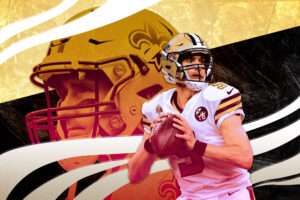
(Photo: The Ringer)
Each year as the NFL Draft approaches, I always say it doesn’t matter when you get drafted (what round or what day) or what school you’re representing. All you need to do is show up, make a name for yourself, and everything will fall into place when and how it’s supposed to. Some of the greatest ever to do it weren’t selected in the first round of the draft, such as Tom Brady, who fell to the sixth round as the 199th overall pick by the New England Patriots—and we all know how that worked out. Warren Moon, Kurt Warner, and John Randle were all undrafted, and each of these men owns a gold jacket. In 2001, the then-San Diego Chargers drafted a quarterback from Purdue named Drew Brees. As expected from the day he announced his retirement in March 2021, Drew has since been selected to join many of his peers in Canton, Ohio, as a member of the Pro Football Hall of Fame.
Drew is one of the three greatest quarterbacks I’ve had the privilege of watching play this game. It was the mix of preparation, a warrior’s spirit, dedication, and leadership that made him into what he ultimately became. Drew was also incredibly reliable—you could count on him to be on the field every week, and when he wasn’t, something was truly wrong. One thing I saw No. 9 do better than many other quarterbacks was spread the football around. If you were open, you were getting the ball, and he trusted you to make a play. One thing I can say is that Drew never consistently had a Hall of Fame–caliber receiver to throw to, outside of Antonio Gates, whom he didn’t play with for long. If you look back, Joe Montana had Jerry Rice, and Peyton Manning had Marvin Harrison. But Drew worked with what he had around him and elevated players such as Lance Moore, Devery Henderson, Brandin Cooks, Marques Colston, Jimmy Graham, and Michael Thomas. It truly didn’t matter who was around him. I often used a label for him during his career: “throwing a guy open.” His intended receiver could be completely covered, yet he would place the football in a certain area—and suddenly, he’s open. His feel for the pocket was always top-notch, and as he got older, I could tell he studied Steve Young when it came to maneuvering within the pocket. Drew could make any throw on the field, and no matter the route, the ball would be right there when the receiver broke out of his release. I enjoyed watching how he orchestrated the offense and changed plays with audibles. It was the command and control he had—making sure everyone was where they needed to be. He’s also one of the smartest players I’ve ever seen play the game. He had a way of fooling defenses, making them think he’d go to one specific receiver, only to beat them with another.
I still remember the day he signed with the New Orleans Saints in free agency in 2006. The Chargers decided to start the Philip Rivers era, which unfortunately meant Drew was the odd man out, and he ended up being released. Joining Sean Payton in New Orleans, the Saints became one of the best teams in the league with Drew under center. In his first year with the team, the Saints were one game away from the Super Bowl. 2009 was a magical year for New Orleans, as the Saints won their first Super Bowl in franchise history at Super Bowl XLIV. Just about every season—or every other season—we heard about him either setting or breaking a record. Drew broke Johnny Unitas’ record for consecutive games with a touchdown pass in 2012 with 48. He is one of the most prolific passers in the history of the game and retired in 2021 second all-time on the passing touchdowns list with 571. Drew is a 13-time Pro Bowler, a two-time Offensive Player of the Year, and a Super Bowl champion. He will be forever celebrated in Canton for the rest of time.

The last good thing about New Orleans football. A legend.