
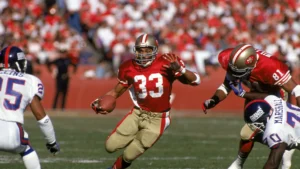
(Photo: NBC Bay Area)
Oftentimes, the die-hard sports fan looks at who the “blue bloods” of a sport are. While this term is usually associated with college sports, it can also be applied at the professional level, especially in the NFL. If I had to list those blue bloods today, I’d say the group consists of the Green Bay Packers, Dallas Cowboys, Pittsburgh Steelers, Chicago Bears, New York Giants, and—from a modern-day perspective—the New England Patriots. One team I would also include is the San Francisco 49ers, a franchise loaded with future legends and Hall of Famers, from head coach Bill Walsh to Joe Montana, Jerry Rice, and eventually Steve Young. And, of course, I can’t forget the legendary Ronnie Lott. Those San Francisco offenses also featured a running back named Roger Craig, who was just as vital to the success of those teams as the stars mentioned above. This August, Roger will finally get his flowers and join the game’s greatest in Canton as a member of the Pro Football Hall of Fame Class of 2026.
Many bigger names have played the running back position—Walter Payton, Eric Dickerson, Jim Brown, Emmitt Smith, and the list goes on. Bill Walsh, the architect of those 49ers offenses, made sure Roger was used to his full ability. He was a physical yet relentless runner. No, Roger didn’t have the elusiveness of Barry Sanders or the punishing style of Earl Campbell, but he was far from a slouch. He ran with a powerful stride and excellent balance through contact. Roger also thrived on inside zone plays and draws. He was often referred to as the heartbeat of the San Francisco offense during its glory days because he did all the dirty work. He controlled tempo, closed out games in the fourth quarter, and his presence opened the field for Joe Montana and Jerry Rice to be lethal. Roger was the perfect fit for Bill Walsh’s offense and was featured in many ways. He lined up as a slot receiver before that role was common in the NFL, turned check-down passes into chunk plays, and, without the ball, protected Joe Montana’s blind side by picking up blitzes. I wouldn’t necessarily label Roger as a safety valve; in my opinion, he was more of a co-star.
The best season of Roger’s career came in 1985, when he made history by becoming the first running back ever to record 1,000 rushing yards and 1,000 receiving yards in the same season. He also finished second in MVP voting behind Marcus Allen, another Hall of Famer. Before LaDainian Tomlinson, Marshall Faulk, Christian McCaffrey, Jamaal Charles, Bijan Robinson, and Alvin Kamara, there was Roger Craig. Every running back listed above owes him credit for opening the door to the dual-threat role. Roger was the first. His peak was shorter and his numbers may not jump off the page, but his impact speaks volumes—and now he’s a member of the greatest club a football player can join.
